What happens when you get hacked? [Lesson 2 in WordPress Security]

What's the worst that could happen?
The owner of a bakery with a simple WordPress website wakes up to a request for $10,000 in Bitcoin – otherwise, their website will be locked.
A hobby eCommerce website is covered in unsavory content, shocking visitors.
The blog you spend hours putting together every month has malicious code uploaded to it, intercepting traffic and serving your visitors with pop-ups full of malware.
And the cherry on top? All of this hits your SEO, reducing the rankings driving your organic traffic.
Welcome to WordPress Security Lesson #2. Today, we're talking consequences.
The SEO consequences
A while back, we reported on a hacking incident.
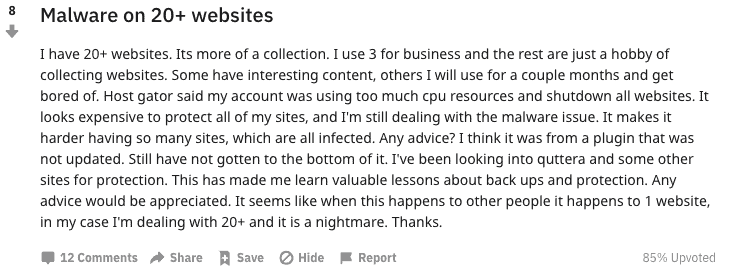
Even though the website owner hired a company to help him clean up after the hack, there were consequences...
"Unfortunately, the problem is not over. My organic search on Google has plummeted. I think some sites got blacklisted and when you search my field/expertise I no longer come up on the first page. After contacting Google to get me back up, I found out it will take 2 - 3 weeks in order to get back up. This means our company could lose.... over 100K by missing out on clients for these few weeks."
Depending on the scale of the hack, it might take months or years to recover the rankings that once drove you traffic and revenue.
Ransomware
Waking up to an email or your site saying that you should pay the attacker in Bitcoin or they'll destroy your files/infect your site with malware is a horrible way to start the day.
However, ransomware is quite common, with around 1.7 million attacks every day.
If you don't have a backup on hand and the attackers have taken over your website completely, you'll have a hard time restoring the infrastructure and trust.
When your site is hacked, you're not the only one affected: your customers and visitors are, too.
Malware and data theft
The only thing nastier than receiving a ransom request is not knowing that your website was hacked and only finding out because your visitors were affected.
If you process payments, attackers could intercept the connection and steal your customers' payment information.
At the very least, they can take charge of the website and fill it with malware. Visitors who trust your brand and, consequently, your site, could be affected.
This leads to not only a huge reputation hit, but significant financial losses.
Leeching resources
Another reason hackers attack your site includes leeching resources, be that making your site a part of their bot net for performing further attacks, exploiting server resources, or simply hosting spam or redirects from your site to theirs.
All of these resources cost money. But if they can attack your site and leech off your resources, it's a big win.
Fines
Finally, breaches of customer data can result in fines under data protection laws like GDPR, CCPA, etc.
If you haven't taken all the security measures, you could be found at fault for a data breach.
You won't just pay for the cleanup
You can clean up a hacked site, but that doesn't mean there won't be long-term consequences. Your data could have been breached or Google may have noticed, blocklisting your site until you prove everything is cleaned.
Even then, it'll take a while to restore the trust and the organic results.
Now that you know what the most common consequences of hacks are (and yes, it can happen to every site), we'll look into the entry points.
The goal? Showing you how to comprehensively protect your site without becoming a security expert.
Get ready for lesson 3 tomorrow!
If you have any questions, just hit "Reply" and let us know.
See you tomorrow!
💚 from Patchstack
Patchstack
Aida 7, ParnuEstonia


You received this email because you signed up on our website or made a purchase from us.

2 links in this issue
- reportedpogapr.clicks.mlsend.com
- 1.7 million attacks every daypogapr.clicks.mlsend.com
Sent by Patchstack WordPress Security Monthly and also published at its own address. Links that track readers or name the subscriber were removed from this copy; its images still load from the sender's own servers. If you publish this newsletter and want an issue corrected or removed, write to us.